
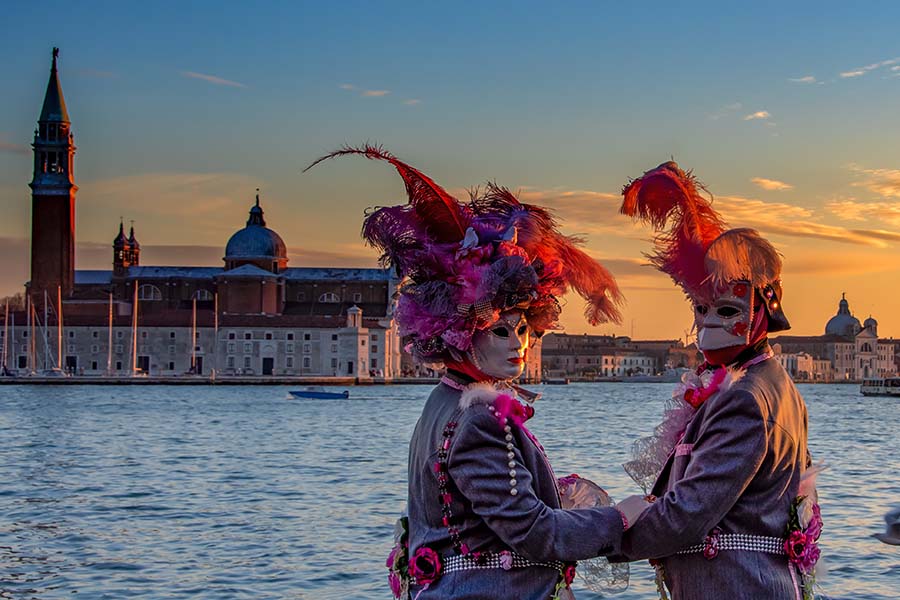
The Venice Carnival is one of the world’s most famous and spectacular festivals, transforming the enchanting lagoon city into an open-air theatre filled with masks, costumes, and centuries-old traditions. Attracting millions of visitors annually, it is a period of pure escapism and creativity before the solemnity of Lent.
What is the Venice Carnival?
The Carnival of Venice is a historic and cultural celebration that precedes the Christian period of Lent. Its roots trace back to 1162, when the Venetians celebrated a military victory. Over the centuries, it became an official public holiday, evolving into a period of sanctioned excess and indulgence before the fasting and abstinence of Lent.
Its fundamental characteristic is the tradition of the mask, which allowed citizens of all social classes to mingle and engage in pleasure while maintaining total anonymity, blurring the lines of social distinction. The modern carnival was officially revived in 1979, aiming to bring back Venice’s rich culture and history.
When does the Venice Carnival begin and how long does it last?
The Venice Carnival typically takes place in February or early March, as the dates are determined by the start of Lent, which is a movable religious holiday.
The festival officially starts about two weeks before Ash Wednesday and ends on Shrove Tuesday (Martedì Grasso). The main events generally concentrate over about 11 days, from the Saturday preceding Fat Thursday (Giovedì Grasso) until Shrove Tuesday. The full schedule of events is released annually, sometimes including “pre-Carnival” festivities.
Where does the Venice Carnival take place and how does it work?
The Venice Carnival is held throughout the city, with the main events concentrated in St. Mark’s Square and the surrounding areas. However, celebrations, performances, and masked figures can be found in many campi (squares), calli (alleys), and along the canals, making the entire city the stage for the festival.
Unlike some other world carnivals, there isn’t one single continuous parade. Instead, the spectacle is everywhere at once, with masked individuals posing for photos and performing in spontaneous shows. Key traditional events mark the festivities:
- Festa Veneziana sull’acqua (Venetian Water Festival): Typically held over the first weekend, it includes a stunning water parade along the Grand Canal.
- Festa delle Marie (Feast of the Maries): A historic procession celebrating 12 young Venetian women in traditional attire, culminating in the crowning of the ‘Maria of the Year.’
- Volo dell’Angelo (Flight of the Angel): One of the central opening events on the first Sunday of the official Carnival, where a performer ‘flies’ on a steel cable from the Campanile di San Marco to the Doge’s Palace in the square below.
- Costume Contest: Daily competitions for the best masked costume, held in Piazza San Marco.
- Official Dinner Shows and Balls: Lavish, exclusive private masquerade balls held in historic palaces (palazzi) like the famous Il Ballo del Doge.
Carnival masks: symbols of tradition and creativity
Venice Carnival masks are the soul of the celebration. Historically, they allowed anonymity and social levelling. Today, they are symbols of exquisite Venetian craftsmanship and theatrical art.
Among the most iconic are:
- Bauta: A full-face mask with a prominent chin and a beaked nose, often worn with a three-cornered hat (tricorno) and a dark cloak (tabarro). The shape allows the wearer to eat and drink without removing it.
- Moretta: An oval, black velvet mask historically worn by women, held in place by a small button clenched between the teeth, making the wearer silent (or muta).
- Medico della Peste (Plague Doctor): Characterized by a long, empty beak mask, historically used by doctors in the 17th-century plague to hold fragrant herbs believed to ward off disease.
How to dress for Venice carnival
How to dress for Venice Carnival depends on the activities you plan to attend.
- For public celebrations: There is no strict dress code to observe the street festivities. However, you can join the spirit by wearing a simple Venetian mask, adding a layer of mystery and fun.
- For Masquerade Balls and Galas: These events are strictly formal and require period costumes (typically 17th or 18th-century Venetian style) and elaborate masks. Costs are generally high, and costumes are often rented from specialized Venetian Ateliers.
Given that the festival is in late winter, remember to dress warmly underneath your costume or bring a cloak!
Curiosities about the Venice Carnival
- Sweet Treats: The traditional sweets of the Carnival are fritole (fried dough balls, sometimes filled with cream or raisins) and galani (crispy, fried pastry strips dusted with powdered sugar).
- The Lion’s Flight: Often the final act of the festivities, a large painted canvas depicting the Lion of St. Mark (Venice’s symbol) descends from the Campanile to conclude the party.
Anonymity: Historically, the mask was so important that the mascherari (mask-makers) had their own guild and a special social status.