
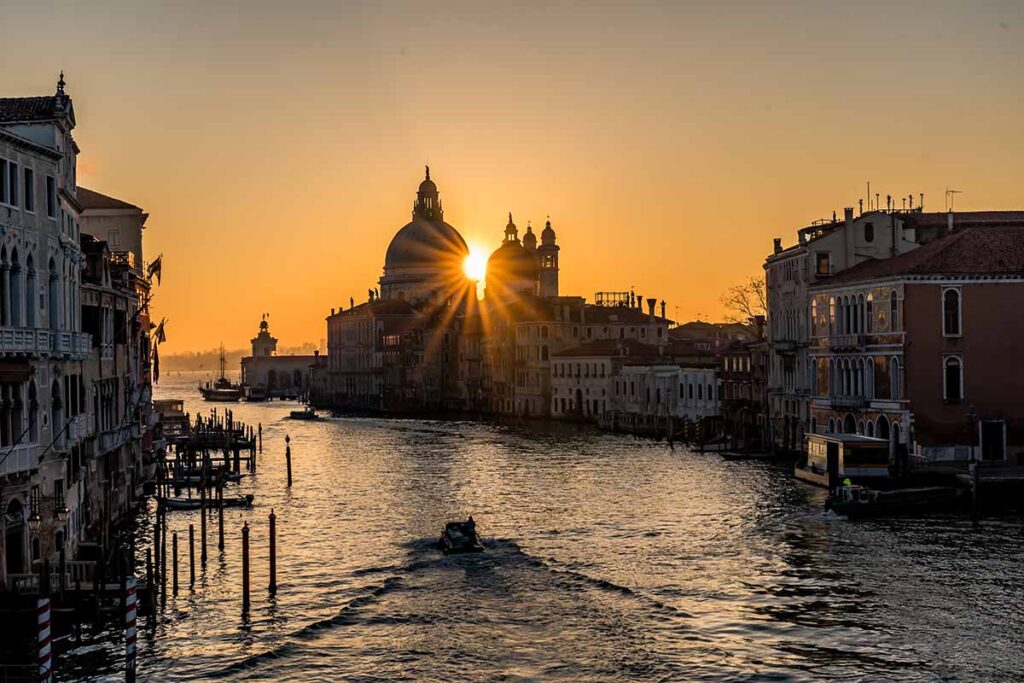
Why Was Venice Built on Water?
The primary reason why Venice was built on water was security and refuge, not romance! In the 5th century AD, as the Western Roman Empire crumbled, the people living in the mainland area known as Venetia (which included modern-day Veneto) faced relentless invasions from Germanic tribes, most notably the Huns led by Attila and later the Lombards.
Seeking a safe haven, the residents fled to the marshy, difficult-to-access lagoons of the Adriatic Sea. These islands, which were essentially uninhabitable mudflats, offered a natural defense mechanism. The shallow waters and shifting sands made it nearly impossible for a land-based army to launch an effective attack. This natural fortress became the foundation for the unique city-state of Venice.
How Was Venice Built on Water?
The question of how was Venice built on water is a testament to ingenious, persistent engineering. Building a city on marshy islands required an unconventional approach, turning the lagoon itself into a stable building surface.
The Venetians started by driving millions of long wooden piles into the soft, muddy seabed until they hit the much harder layer of compressed clay, known as ′′caranto′′. These tree trunks, mostly from oak, larch, or pine, were imported from the nearby forests of the Italian mainland, Istria, and Dalmatia. They were driven in close together and, once submerged, became petrified.
The lack of oxygen in the water and the constant contact with mineral-rich salt water prevented the wood from rotting. Instead, it hardened into a stone-like substance over time. Once the wooden foundation was set, stone bases (usually Istrian stone, a dense, non-porous limestone) were laid on top of the piles, and the masonry for the buildings was then constructed on these solid foundations. This process created a surprisingly stable platform for the city.
The Engineering Behind Venice’s Floating City
The engineering behind Venice’s unique structure relies on a few key principles:
- Piles and ‘Caranto’: The millions of wooden piles act like deep foundations, transferring the weight of the buildings down through the soft mud to the stable clay layer below.
- The Power of Water: The lack of oxygen under the water is the crucial element. It stops the micro-organisms that cause wood decay. The constant immersion and presence of salt minerals actually helps to ‘cure’ and preserve the wood, turning the foundation into a permanent, resilient structure.
- Istrian Stone: This non-porous stone was vital for the first layer above the water. It prevents the salt water from rising through capillary action into the above-ground bricks, which would otherwise be quickly destroyed.
When Was Venice Built on Water? A Historical Timeline
While it’s not a single date, the process of when was Venice built on water spans centuries:
- 5th Century AD: The earliest settlements begin as refugees flee the mainland invasions to the islands of the lagoon, such as Torcello and Malamocco.
- 9th Century AD: The political and economic center shifts to the Rivo Alto island group $\text{\–}$ the site of modern Rialto. This marks the true beginning of the city we know today. Systematic development of the wooden-pile foundations began in earnest during this period.
- 10th to 15th Centuries AD: This was the major construction boom period, fueled by the rising wealth of the Venetian Republic. Most of the iconic palaces, churches, and civic structures were built using the pile foundation technique, solidifying the city’s structure.
How Venice Stays Afloat: Foundations & Structures
The entire city is not actually ′′floating′′; it is resting on millions of pilings. The city of Venice was built on the water by a system of reinforcing the natural marshy ground. Essentially, the Venetians took the unstable lagoon floor and turned it into a massive, stable wooden grid.
The buildings in Venice, while seemingly heavy, are structurally designed to minimize excessive load. They are supported by a widespread network of small wooden piles beneath almost every wall, distributing the weight evenly across the entire building footprint. The network of canals then helps to relieve pressure on the land by separating the clusters of buildings.
Challenges of a City Built on Water
Despite the brilliant engineering, building on water presents modern challenges. Rising sea levels and the natural phenomenon of subsidence (the gradual sinking of the ground) pose a severe threat. This combination is why the city experiences frequent flooding, known as Acqua Alta (high water).
To combat this, the Italian government has implemented the MOSE (Modulo Sperimentale Elettromeccanico) project $\text{\–}$ a system of mobile barriers designed to isolate the Venetian Lagoon from the Adriatic Sea during high tides, an ongoing effort to preserve this historical, watery marvel.